IOB researchers, in collaboration with a team from Radboud University Medical Center and partners from more than 100 institutions worldwide, identify new genetic cause of inherited blindness. The study team discovers RNA mutations that explain previously undiagnosed cases of retinitis pigmentosa, opening new diagnostic pathways for thousands of patients.
A long-missing genetic explanation for inherited vision loss
Retinitis pigmentosa (RP) is a genetic eye disorder affecting around one in 5,000 people worldwide. It typically begins with night blindness in youth and progresses to tunnel vision as daylight-sensing photoreceptor cells in the retina gradually die, potentially leading to blindness over time. Although more than a hundred genes have been linked to RP, the genetic cause remains undiagnosed in ~30-40% of patients, even after extensive DNA testing. For many families, this has meant years without clear answers about their inherited vision loss.
That uncertainty is now beginning to lift: Researchers at the Institute of Molecular and Clinical Ophthalmology Basel (IOB), working with more than 130 institutions worldwide, analyzed genetic data from almost 5’000 individuals across 62 families affected by RP. The disease-causing changes were not found in protein-coding genes. In 153 patients, the researchers instead identified changes in RNA molecules involved in the cell’s splicing machinery, which edits genetic information before proteins are made.
Key findings:
- Variants in five non-coding RNA genes (RNU4-2, RNU6-1, RNU6-2, RNU6-8 and RNU6-9) cause retinitis pigmentosa. These genes produce RNA molecules rather than proteins, representing a largely unexplored source of inherited blindness.
- The variants are both inherited and spontaneous. Some were passed down through generations; others appeared for the first time in affected individuals.
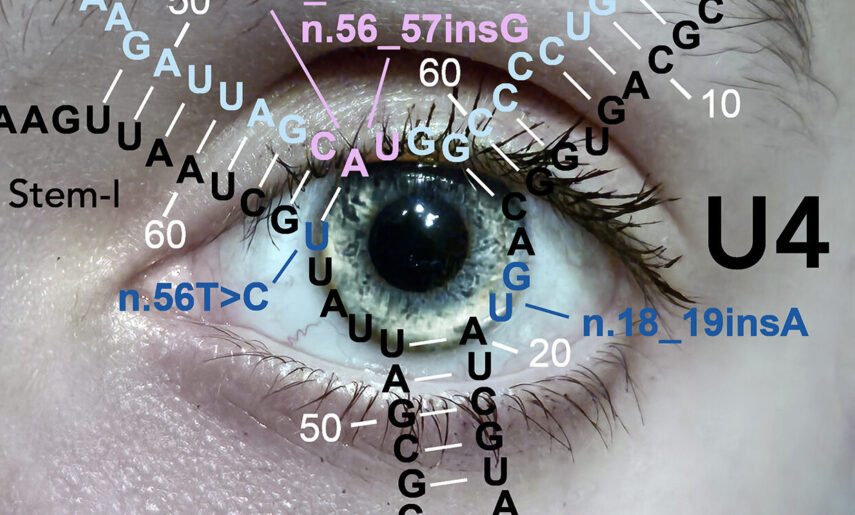
- All variants cluster in the same critical region, where the U4 and U6 RNA molecules, encoded by the RNU4 and RNU6 genes on the DNA, connect. This is a key interaction site for multiple proteins involved in RNA splicing.
- One same gene can cause different diseases. While certain variants in RNU4-2 lead to neurodevelopmental disorders, those identified here specifically target the retina.
“Retinitis pigmentosa has been studied genetically for decades, yet a substantial fraction of cases remained unexplained. Our findings show that the missing pieces were not additional protein-coding genes, but RNA genes that play a central role in how genetic information is processed. This forces us to rethink where we look for disease-causing variants in inherited blindness.”
CARLO RIVOLTA, Head of the Ophthalmic Genetics Group at IOB and senior co-author of the study
This discovery solves a puzzle. While it was already known that some proteins involved in RNA splicing (PRPF3, PRPF8, and PRPF31) cause RP when mutated, this study reveals that the RNA molecules of the splicing machinery can also have disease-causing variants. In other words, multiple parts of the same cellular process, when broken, lead to the same condition.
“What surprised us most was how consistent the signal was. All the variants we found affect the same small region of the splicing machinery, even though they occur in different genes. This tells us that the precise architecture of this RNA complex is essential for retinal health, and that even subtle disruptions can have profound consequences for vision.”
MATHIEU QUINODOZ, Senior scientist in the Ophthalmic Genetics Group at IOB, first author of the study
For the families included in this study, the impact is concrete. These variants explain up to 1.4% of previously undiagnosed RP cases, which means that dozens of families worldwide can now receive a precise molecular diagnosis. They can access genetic counselling, make informed decisions about family planning, and position themselves for future treatments as they emerge.
“We have learned that changes in these RNA genes can be just as impactful as changes in protein-coding genes. This is fundamental knowledge that broadens our understanding of hereditary diseases.”
SUSANNE ROOSING, molecular geneticist at Radboud University Medical Center and senior co-author of the study
More broadly, this study is an important step forward in the understanding of hereditary blindness. By looking beyond protein-coding genes into overlooked regions of the genome, researchers have expanded the diagnostic landscape. As genetic testing evolves and RNA-based therapies advance, these findings lay essential groundwork for identifying more patients and, ultimately, developing treatments for a disease that currently has no cure.
Scientific contact:
Carlo Rivolta, Head of the Ophthalmic Genetics Group
E-Mail: carlo.rivolta@iob.ch
Illustration: © Carlo Rivolta, 2026, all rights reserved
Original Publication
De novo and inherited dominant variants in U4 and U6 snRNA genes cause retinitis pigmentosa
Mathieu Quinodoz, Kim Rodenburg, Zuzana Cvackova, Karolina Kaminska, Suzanne E. de Bruijn, Ana Belén Iglesias-Romero, Erica G. M. Boonen, Mukhtar Ullah, Nick Zomer, Marc Folcher, Jacques Bijon, Lara K. Holtes, Stephen H. Tsang, Zelia Corradi, K. Bailey Freund, Stefanida Shliaga, Daan M. Panneman, Rebekkah J. Hitti-Malin, Manir Ali, Ala’a AlTalbishi, Sten Andréasson, Georg Ansari, Gavin Arno, Galuh D. N. Astuti, Carmen Ayuso, Radha Ayyagari, Sandro Banfi, Eyal Banin, Tahsin Stefan Barakat, Mirella T. S. Barboni, Miriam Bauwens, Tamar Ben-Yosef, Virginie Bernard, David G. Birch, Pooja Biswas, Fiona Blanco-Kelly, Beatrice Bocquet, Camiel J. F. Boon, Kari Branham, Dominique Bremond-Gignac, Alexis C. Britten-Jones, Kinga M. Bujakowska, Cyril Burin des Roziers, Elizabeth L. Cadena, Giacomo Calzetti, Francesca Cancellieri, Luca Cattaneo, Naomi Chadderton, Peter Charbel Issa, Luísa Coutinho-Santos, Stephen P. Daiger, Elfride De Baere, Marieke De Bruyne, Berta de la Cerda, John N. De Roach, Julie De Zaeytijd, Ronny Derks, Claire-Marie Dhaenens, Lubica Dudakova, Jacque L. Duncan, G. Jane Farrar, Nicolas Feltgen, Beau J. Fenner, Lidia Fernández-Caballero, Juliana M. Ferraz Sallum, Simone Gana, Alejandro Garanto, Jessica C. Gardner, Christian Gilissen, Roser Gonzàlez-Duarte, Kensuke Goto, Sam Griffiths-Jones, Tobias B. Haack, Lonneke Haer-Wigman, Alison J. Hardcastle, Takaaki Hayashi, Elise Héon, Lies H. Hoefsloot, Alexander Hoischen, Josephine P. Holtan, Carel B. Hoyng, Manuel Benjamin B. Ibanez IV, Chris F. Inglehearn, Takeshi Iwata, Brynjar O. Jensson, Kaylie Jones, Vasiliki Kalatzis, Smaragda Kamakari, Marianthi Karali, Ulrich Kellner, Caroline C. W. Klaver, Krisztina Knézy, Robert K. Koenekoop, Susanne Kohl, Taro Kominami, Laura Kühlewein, Tina M. Lamey, Rina Leibu, Bart P. Leroy, Petra Liskova, Irma Lopez, Victor R. de J. López-Rodríguez, Quinten Mahieu, Omar A. Mahroo, Gaël Manes, Luke Mansard, M. Pilar Martín-Gutiérrez, Nelson Martins, Laura Mauring, Martin McKibbin, Terri L. McLaren, Isabelle Meunier, Michel Michaelides, José M. Millán, Kei Mizobuchi, Rajarshi Mukherjee, Zoltán Zsolt Nagy, Kornelia Neveling, Monika Ołdak, Michiel Oorsprong, Yang Pan, Anastasia Papachristou, Antonio Percesepe, Maximilian Pfau, Eric A. Pierce, Emily Place, Raj Ramesar, Francis Ramond, Florence Andrée Rasquin, Gillian I. Rice, Lisa Roberts, María Rodríguez-Hidalgo, Javier Ruiz-Ederra, Ataf H. Sabir, Ai Fujita Sajiki, Ana Isabel Sánchez-Barbero, Asodu Sandeep Sarma, Riccardo Sangermano, Cristina M. Santos, Margherita Scarpato, Hendrik P. N. Scholl, Dror Sharon, Sabrina G. Signorini, Francesca Simonelli, Ana Berta Sousa, Maria Stefaniotou, Kari Stefansson, Katarina Stingl, Akiko Suga, Patrick Sulem, Lori S. Sullivan, Viktória Szabó, Jacek P. Szaflik, Gita Taurina, Alberta A. H. J. Thiadens, Carmel Toomes, Viet H. Tran, Miltiadis K. Tsilimbaris, Pavlina Tsoka, Veronika Vaclavik, Marie Vajter, Sandra Valeina, Enza Maria Valente, Casey Valentine, Rebeca Valero, Sophie Valleix, Joseph van Aerschot, L. Ingeborgh van den Born, Mattias Van Heetvelde, Virginie J. M. Verhoeven, Andrea L. Vincent, Andrew R. Webster, Laura Whelan, Bernd Wissinger, Georgia G. Yioti, Kazutoshi Yoshitake, Juan C. Zenteno, Roberta Zeuli, Theresia Zuleger, Chaim Landau, Allan I. Jacob, Siying Lin, Frans P. M. Cremers, Winston Lee, Jamie M. Ellingford, David Stanek, Susanne Roosing, Carlo Rivolta
Nature Genet. 2026 Jan 9.
doi: 10.1038/s41588-025-02451-4