Our Story
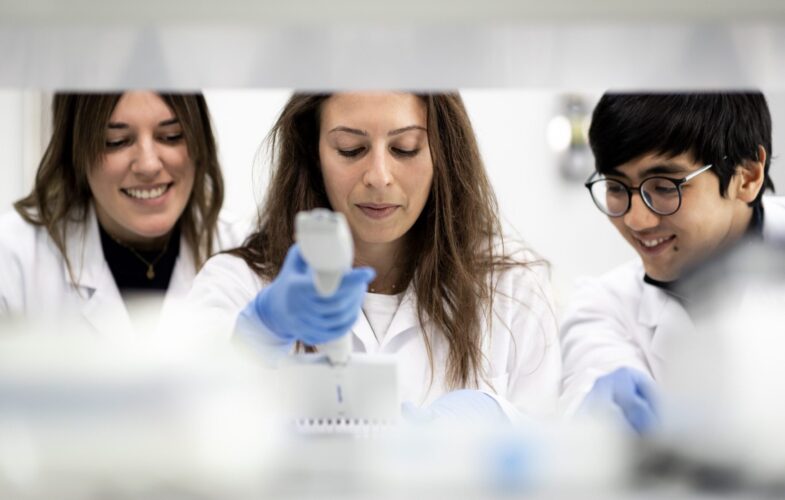
At the Institute of Molecular and Clinical Ophthalmology Basel (IOB), basic researchers and clinicians work hand in hand to advance the understanding of vision, its diseases and to develop new therapies for vision loss.
The Institute of Molecular and Clinical Ophthalmology Basel (IOB) was established in December 2017 through a collaborative effort of the University of Basel, the University Hospital Basel, and Novartis. The Canton of Basel-Stadt has granted substantial financial support to the institute. IOB officially started operations in 2018.
The founding of IOB was driven by pressing global healthcare needs in ophthalmology. Eye diseases are becoming increasingly prevalent worldwide, and many lack effective treatments. In aging societies, disorders such as macular degeneration and glaucoma have emerged as leading causes of disability and loss of independent lifestyle. Additionally, myopia, or short-sightedness, is on a steep incline, particularly in Asia, where up to 90% of teenagers are affected in some regions. This often-overlooked condition poses a significant risk for the development of various blinding complications, including myopic macular degeneration, glaucoma, and retinal detachment.
IOB is guided by the Board of Trustees (governance and oversight), the Executive Board (leadership and operations) and the Scientific Advisory Board (scientific guidance).
The prevalence of eye diseases is constantly rising.
At IOB, researchers and clinicians work hand in hand to develop new therapies.
Our mission and core purpose
IOB’s mission is to advance the understanding of vision and its diseases, and to develop new therapies for vision loss. The institute’s model for success is built on a unique approach that combines fundamental research with translational capabilities, focusing on therapy development using human models.
At the heart of IOB’s work is the synergy between basic researchers and clinicians. This collaboration aims to bridge the gap between laboratory discoveries and clinical applications, accelerating the pace of innovation in ophthalmology.
We unite researchers and clinicians to restore vision.