Working at IOB
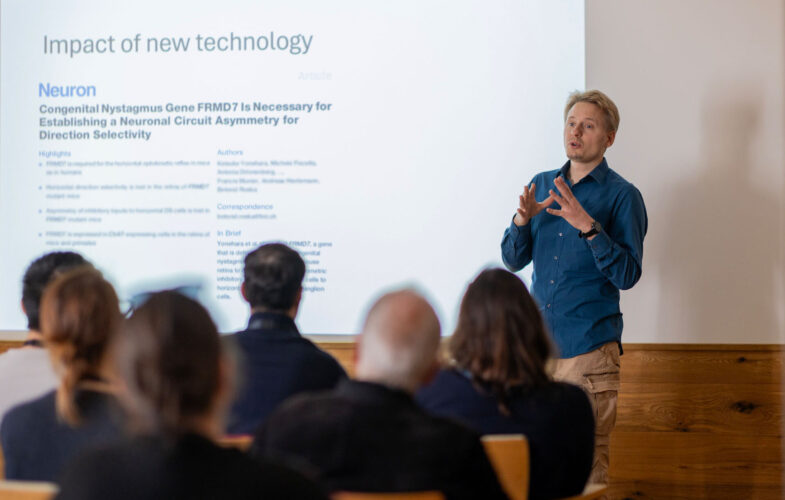
IOB is a place where your expertise will be valued, your abilities challenged, and your knowledge expanded.
IOB is a research institute that combines basic and clinical research. Its mission is to advance the understanding of vision and its diseases and to develop new therapies for vision loss.
At IOB, scientists from basic and clinical disciplines work closely together to study the structure, function, and disease mechanisms of the retina and other visual systems, and to translate these insights into innovative treatments.
Our research environment
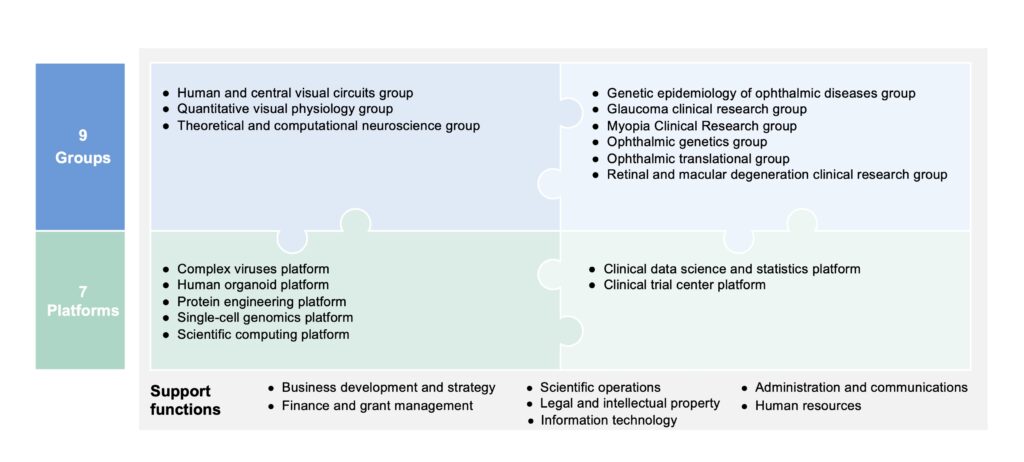
Our institute is organised around closely collaborating research groups, technology platforms, and translational projects.
Research groups conduct basic and clinical vision research and are embedded in the academic environment of the University of Basel.
Technology platforms develop and provide advanced methods and expertise that contribute to research and translation across the institute.
Translational projects bring together multiple groups and platforms to move discoveries from fundamental research towards clinical application.
This collaborative structure is supported by dedicated operational and administrative teams.
IOB fosters collaboration between clinicians, researchers, and operational staff through diverse regular gatherings. These range from governance meetings to public seminars, facilitating knowledge exchange and interdisciplinary cooperation across the organization.
People and culture
IOB offers a diverse, international, and inclusive working environment.
Our core values guide actions and decision-making across the organisation.
The institute’s staff is predominantly composed of researchers, spanning all career stages from doctoral and postdoctoral training to faculty members with academic appointments.
IOB offers a structured PhD and MD-PhD training program designed to enable breakthrough discoveries in vision research and to support the development of novel therapies and diagnostic tools for visual disorders.
Our scientists and clinicians have access to world-class research partners and state-of-the-art technology and are fully supported in their professional development.