Perception depends not only on what we see, but also on when we see it. Signals initiated by light-sensitive cells in the retina travel through nerve fibers of varying lengths before converging at the optic nerve and continuing to the brain. Even neighboring cells in the central retina can transmit signals over very different distances, raising the question of how the brain avoids receiving a scrambled or delayed picture of the world.
A study recently published by researchers of the Institute of Molecular and Clinical Ophthalmology Basel (IOB) in Nature Neuroscience shows that differences in the speed and distance of nerve signals are actively balanced within the human eye itself to support a unified and temporally accurate visual experience.
Key findings:
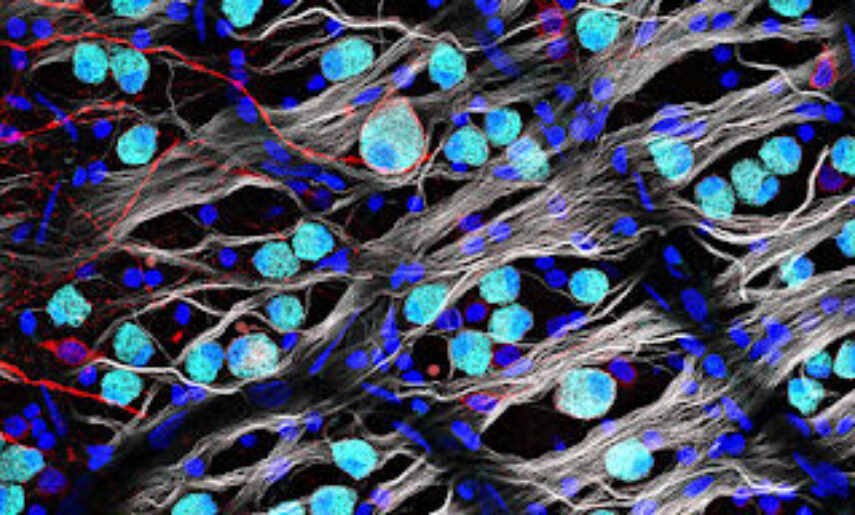
- Axonal tuning in the human retina: Longer axons of retinal ganglion cells have larger diameters and faster conduction speeds, which helps align signal arrival times.
- Precision in milliseconds: This mechanism helps align the timing of signals from different parts of the retina, reducing differences in arrival time to just a few milliseconds.
- Multiple layers of compensation: Alongside axon speed, other factors like the initial response time of retinal cells and further adjustments in the brain contribute to synchronization.
IOB researchers reveal that the fine-tuning of visual timing in humans begins not in the brain but in the retina, thus challenging previous assumptions. They show that this built-in compensation helps maintain the clarity and consistency of what we see despite structural differences in how signals are routed through the eye.
These findings raise important questions about how nerve fibers are adjusted during development – for example, how their diameter is regulated and how their membranes help control the speed of signal transmission. Understanding these mechanisms could reveal fundamental principles of temporal coordination in the brain, with relevance well beyond the visual system.
Original Publication
Synchronization of visual perception within the human fovea
Annalisa Bucci, Marc Büttner, Niklas Domdei, Federica B. Rosselli, Matej Znidaric, Julian Bartram, Tobias Gänswein, Roland Diggelmann, Martina De Gennaro, Cameron S. Cowan, Wolf Harmening, Andreas Hierlemann, Botond Roska and Felix Franke
Nature Neuroscience 2025 Sep;28(9):1959-1967.
doi: 10.1038/s41593-025-02011-3. Epub 2025 Jul 16.