Lessons from 20,000 lab-grown human retinas
Key findings:
- More than 2,700 compounds were tested in 20,000 human retinal organoids
- Some compound classes were found to damage cones, highlighting safety risks
- Several molecules were identified that protect cone photoreceptors from degeneration
- Inhibition of casein kinase 1 emerged as a key protective mechanism
Cone photoreceptors, concentrated in the macula, are essential for reading, recognizing faces, and perceiving colours. Their death, as it happens in many inherited retinal diseases and macular degeneration, leads to the loss of central vision. Despite decades of research, no approved therapies can halt this process. This new study, conducted by first authors Stefan Spirig, Alvaro Herrero Navarro and collaborators, addresses this unmet need using a human-based experimental system.
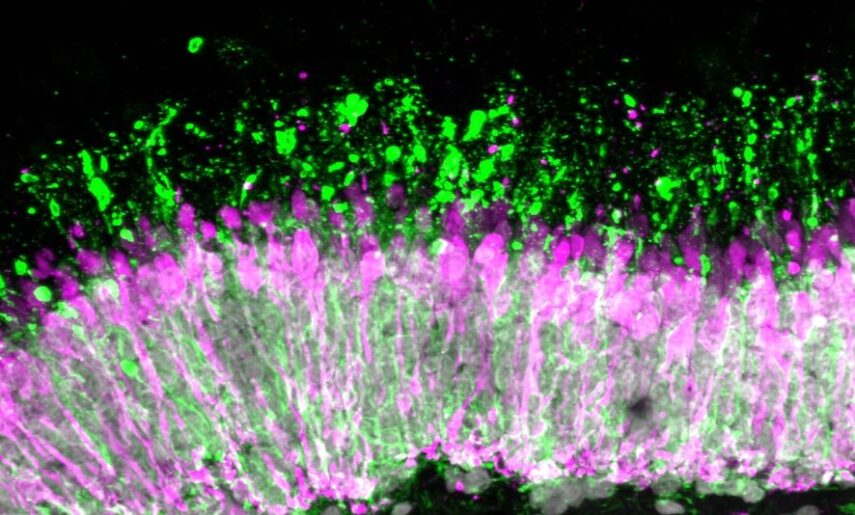
Cone photoreceptors were selectively labelled, allowing their fate to be followed over time under controlled stress conditions that mimic disease. This approach enabled a systematic screen of compounds with known molecular targets.
Clear patterns emerged: two kinase inhibitors consistently protected cones over extended periods. The protective effects held across different stress conditions and were further confirmed in a mouse model of retinal degeneration, supporting their broader relevance.
Beyond identifying protective pathways, the study makes a comprehensive dataset publicly available, covering the compounds tested, their molecular targets, and their effects on human cone survival. This resource will guide the development of therapies aimed at preserving central vision and enable a systematic assessment of potential retinal toxicity.
By combining retinal biology, organoid technology, and large-scale compound screening, the work gives researchers a head start in developing new treatments and sharpens focus on a long-standing goal in ophthalmology: protecting the very cells that make sight possible.
“By screening thousands of compounds directly in human retinal tissue, we identified concrete targets and molecules that could form the basis for new therapies to preserve vision, while making the entire dataset openly available to accelerate progress across the field.”
STEFAN SPIRIG & ALVARO HERRERO-NAVARRO, co-first authors of the paper
Scientific contact:
Botond Roska, Head of the Human Retinal and Central Visual Circuits Group
E-Mail: headoffice_roska@iob.ch
Illustrations: © IOB, 2026, all rights reserved
Original Publication
Cell type-focused compound screen in human organoids reveals CK1 inhibition protects cone photoreceptors from death
Stefan E. Spirig, Álvaro Herrero-Navarro, Larissa Utz, Valeria J. Arteaga-Moreta, Zoltan Raics, Susana Posada-Céspedes, Stephanie Chreng, Olaf Galuba, Inga Galuba, Isabelle Claerr, Steffen Renner, Miklos Boldogkoi, Verónica Moreno-Juan, P. Timo Kleindienst, Adrienn Volak, Jannick Imbach, Svitlana Malysheva, Rebecca A. Siwicki, Vincent Hahaut, Yanyan Hou, Tiago M. Rodrigues, Simone Picelli, Marco Cattaneo, Josephine Jüttner, Cameron S. Cowan, Myriam Duckely, Daniel K. Baeschlin, Magdalena Renner, Vincent Unterreiner, Botond Roska
Neuron. 2026 March 30.
doi: http://10.1016/j.neuron.2026.02.024
Recent News